Climate Change
Analysis Process
We identify climate change as one of our material issues and, in accordance with our Environmental Policy, we are working to reduce our environmental impact across the entire supply chain, from raw material procurement and production to logistics, stores, and waste disposal. Toward the realization of a decarbonized society, we are accelerating efforts to reduce energy consumption and introduce renewable energy across our domestic operations. We are also working to halve the intensity of our plastic resource use and promote resource circulation. Through these initiatives, we aim to contribute to a sustainable society while enhancing our corporate value over the medium to long term.
Our Group has assessed the potential impact of climate change on our business with reference to the categories of risks and opportunities identified in the recommendations of the Task Force on Climate-related Financial Disclosures (TCFD). We conducted analyses under two scenarios – the 1.5℃ scenario and the 4℃ scenario – covering changes in policies and market trends (transition risks and opportunities) as well as physical changes resulting from natural disasters and other factors (physical risks and opportunities). Based on these analyses, we identified risks and opportunities, assessed their potential impact on our business, and developed response measures.

Climate Change Scenarios
In conducting our scenario analysis, we established two scenarios with reference to reports published by the International Energy Agency (IEA) and the Intergovernmental Panel on Climate Change (IPCC). Going forward, we will continue to periodically review our identified risks and opportunities and our response measures, taking into account changes in climate-related parameters and the business environment.
| Decarbonization Transition Scenario (1.5℃ Scenario) |
High-Emissions Scenario (4℃ Scenario) |
|
|---|---|---|
| Assumed Society | A society in which ambitious policies and technological innovations are implemented to support the transition to a decarbonized society, with the aim of limiting the increase in global average temperature to 1.5℃ above pre-industrial levels by the end of this century. Stricter regulations, the introduction of carbon taxes, and changes in consumer environmental awareness have a significant impact across the entire supply chain. | A society in which climate change mitigation efforts make little further progress from current levels, resulting in an increase of approximately 4℃ in global average temperature by around the end of this century. Extreme weather events, including severe heatwaves and heavy rainfall, become more intense and frequent, significantly increasing the risks of reduced agricultural yields and damage to business sites caused by large-scale flooding. |
| Reference Scenarios | IEA :NZE 2050 IPCC:SSP1-1.9 (equivalent to RCP1.9) |
IPCC:SSP5-8.5 (equivalent to RCP8.5) |
Change in Global Average Temperature Relative to the 1850–1900 Baseline
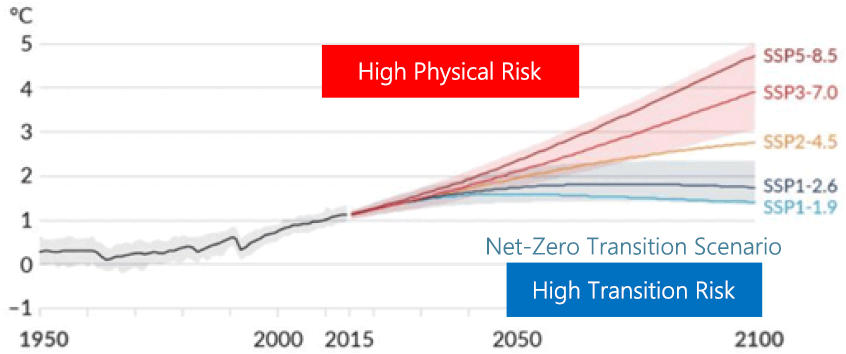
Source: Figure SPM.8 reproduced from the Summary for Policymakers of the Working Group I contribution to the IPCC Sixth Assessment Report, based on the provisional Japanese translation by the Ministry of Education, Culture, Sports, Science and Technology and the Japan Meteorological Agency.
Our Key Climate-Related Risks and Opportunities
Based on the TCFD recommendations, our Group analyzed the potential impact of climate change on our business under two scenarios: the 1.5℃ scenario, representing a transition to a decarbonized society, and the 4℃ scenario, representing a high-emissions society.
| Risk | Driver | Time Horizon |
Impact on Our Business | Impact | Risk Response Measures | |
|---|---|---|---|---|---|---|
| Transition Risks |
Policy and Regulation |
GHG emission prices | Medium to long term |
Increase in energy-related costs resulting from carbon taxes imposed on our Scope 1 and Scope 2 emissions | Medium |
|
| Stronger emissions reporting requirements | Short to medium term |
Increase in outsourcing costs and costs associated with maintaining management systems as a result of measuring and disclosing emissions across the entire supply chain, including Scope 3 emissions | Low |
|
||
| Mandates and regulations affecting existing products and services | Medium to long term |
Shift to alternative materials in response to stricter plastic regulations, along with increased packaging material costs | Medium |
|
||
| Markets | Rising raw material costs | Short to long term |
Higher procurement costs for key raw materials due to rising market prices | High |
|
|
| Changes in customer behavior | Medium to long term |
Decline in customer traffic and sales at existing business formats due to higher prices resulting from future carbon taxes and similar measures, as well as changes in consumer environmental awareness | High |
|
||
| Reputation | Growing stakeholder concerns or negative stakeholder feedback | Short to long term |
Damage to our employer brand resulting from delays in addressing environmental issues, as well as increased recruitment costs to secure talent | Low |
|
|
| Physical Risks |
Chronic | Rising average temperatures | Medium to long term |
Significant declines in store traffic and sales as record-breaking summer heat discourages customers from going out | Medium |
|
| Sea-level rise | Long term | Potential relocation costs if logistics facilities or stores need to be relocated due to future sea-level rise | Low |
|
||
| Acute | Increasing severity of extreme weather events, including cyclones and flooding | Short to long term |
Supply disruptions and product shortages resulting from damage to facilities caused by large-scale flooding, as well as reduced sales due to lost business opportunities | High |
|
|
| Opportunity | Resource Efficiency | Use of more efficient production and distribution processes | Short to long term |
Reducing food loss at stores and factories, and lowering raw material and disposal costs through AI-driven demand forecasting | Low |
|
| Increased use of recycling | Medium to long term |
Generating revenue from by-products and reducing disposal costs by developing systems to convert used cooking oil into sustainable aviation fuel (SAF) and fertilizer | Low |
|
||
| Development and introduction of high-efficiency equipment | Short to long term |
Improving energy efficiency and continuously reducing utility costs by upgrading to energy-saving equipment across all stores | Low |
|
||
| Reduction in water use and consumption | Short to long term |
Mitigating utility cost increases amid potential future increases in water prices by introducing water-efficient cooking and washing equipment | Low |
|
||
| Energy Sources | Adoption of new technologies | Medium to long term |
Lowering store and facility operating costs by optimizing energy management using IoT and AI | Low |
|
|
| Products and Services | Development and expansion of low-emission products and services | Short to long term |
Enhancing brand loyalty and maintaining and expanding sales as a brand of choice through the adoption of environmentally preferable materials | Low |
|
|
| Responding to changes in consumer preferences | Medium to long term |
Attracting new environmentally conscious customer segments and creating new revenue categories by expanding alternative meat menu offerings | Medium |
|
||
| Medium to long term |
Establishing a stable source of revenue through expanded e-commerce and frozen packaged product sales to offset declines in store traffic caused by adverse weather | Medium |
|
|||
| Market | Leveraging public-sector incentives | Short to long term |
Building trust in our stores as part of local infrastructure by developing them as disaster preparedness hubs, thereby enhancing corporate value and intangible assets | Low |
|
|
| Resilience | Resource substitution and diversification | Medium to long term |
Stabilizing raw material quality under extreme weather conditions and mitigating procurement cost volatility through technical support for producers | Low |
|
|
| Strengthening supply chain resilience | Medium to long term |
Minimizing future extraordinary losses and repair costs resulting from physical damage by optimizing the allocation of business sites based on risk data | Medium |
|
||
Time Horizons
- Short term: 2026–2027
- Medium term: 2028–2029
- Long term: 2030–2050
Impact Levels
- Low: May result in minor economic losses, but the impact on business operations is expected to be limited
- Medium: May result in economic losses of a certain magnitude and may affect business operations
- High: May result in significant economic losses and seriously affect business continuity
Risks and Opportunities Identified as Particularly Significant
We assess the potential impact of each identified risk and opportunity. For those considered particularly significant, we conduct more detailed analyses and consider appropriate response measures to minimize risks and maximize opportunities.
| Risk/ Opportunity |
Impact on Our Business | Financial Impact (FY2029) |
Calculation Methodology and Key Assumptions |
|---|---|---|---|
| Transition Risk | Increase in energy-related costs resulting from carbon taxes imposed on our Scope 1 and Scope 2 emissions | ¥2,658 million | Estimated carbon tax liability based on projected GHG emissions upon achievement of our reduction targets
|
| Physical Risk | Reduced sales resulting from supply disruptions and product shortages caused by damage to business sites due to large-scale flooding, as well as lost business opportunities | ¥824 million | Estimated the incremental expected loss attributable to climate change
|
| Opportunity | Establishment of a stable revenue source through expanded e-commerce and frozen packaged product sales to offset declines in store traffic caused by adverse weather conditions and extreme heat | ¥1,376 million | Estimated the incremental revenue contribution from strengthening our external sales business
|